
Preserving humanity’s 'genetic Adam'
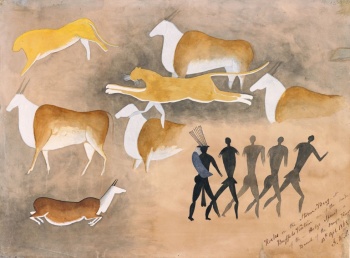
An image from the Digital George Stow collection of Southern African rock art from the Digital Bleek and Lloyd Collection. It shows five figures, one of whom wears what resembles a quiver and a spiked headdress. There are five antelope – one sits or runs with legs folded – and two predators resembling lions – the central one is leaping with outstretched legs. Image courtesy Digital Bleek and Lloyd Collection.
A new citizen science project invites the public to preserve the endangered culture of one of the oldest indigenous people of southern Africa. These hunter-gatherers could be related to our ‘genetic Adam’, the common male ancestor for everyone alive today who lived 60,000 years ago says Spencer Wells, a US geneticist leading the Genographic Project.
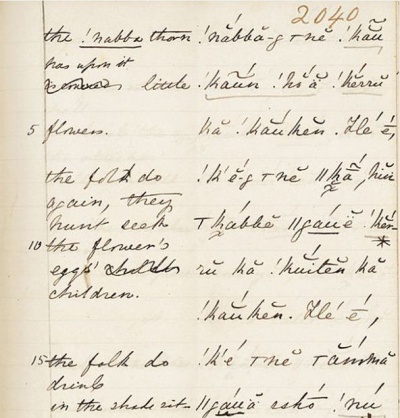
These ancient group of nomadic hunter-gatherers are famous for their click-based languages called |xam and !kun (the punctuation characters represent different click consonants). But, even though these people have no collective names for themselves as a whole, ethnic relatives, historic rivals, and colonists have given them all-inclusive names, which all have at least some sort of pejorative meaning.
The Transcribe Bushman project is a collaboration of the Citizen Cyberscience Center (CCC), based in CERN, Switzerland, and the University of Cape Town, South Africa, and aims to transcribe these ancient languages. The project tool is developed by Ngoni Munyaradzi, a Masters student at the Digital Libraries Laboratory, in the University of Cape Town, which is led by computer scientist Hussein Suleman.
"This project has its roots in workshops that the CCC has run in Africa since 2007 to catalyze uptake of citizen science by scientists in the region,” says François Grey, coordinator of the CCC. “It's great to see the research focuses on preserving African cultural heritage. Hopefully it will inspire other researchers in Africa to do likewise."
The project has created an open-source platform, based on the Bossa framework that provides applications and tools so that the public can transcribe the notebooks of languages stored in the Digital Bleek and Lloyd Collection.
The Digital Bleek and Lloyd Collection is a digitized version of the archive of |xam and !kun languages texts created by German linguist Wilhelm Bleek and Lucy Lloyd in the 19th century.
Transcribing endangered languages
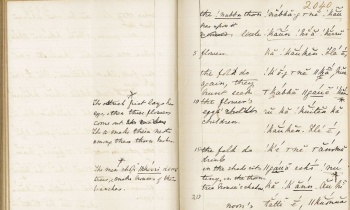
Two pages from notebooks of the Digital Bleek and Lloyd Collection which the public can transcribe. On the right page, the indigenous language can be seen on the right-hand-side column and the English translation is on the left-hand-side column. Notes are on the left page. Image courtesy Digital Bleek and Lloyd Collection.
Today, there aren’t many living speakers of these languages so they’re officially classed as endangered. The languages incorporate a ‘click’ sound, which is created by a sucking action of the tongue. The click noise can be changed by altering the way air is released. For example, the “!” is a noise made with the tongue to imitate a cork popping from a bottle. The sound “/” is a dental sound, similar to ‘tutting’ or ‘tsk tsk’ sounds, while “//” is a lateral sound similar to a horse rider urging their horse to move.
The project has created a free online transcription tool that enables digital encoding.
Once a user signs up to the website, they can copy extracts of indigenous language and the English translation directly from the digitized notebooks onto an online interface, with the help of embedded tools. Anyone can join; an instructive video tutorial is available. It’s recommended that you expand the screen size and increase audio volume for clarity.
Since the transcription tool was completed just over five weeks ago, the site has received 72 registered users and has transcribed 25 pages. If successful, future projects could look at translating the text to speech.
More information about the Transcribe Bushman project can be found on the My Science Work blog.
- Adrian Giordani
Digital Stream
-
ICYMI: #HPC resources & hi-res satellite imagery used to aid #NepalEarthquake disaster relief: http://t.co/1oFT4oRPZ9 http://t.co/uwPJt5R8rI
2 hours 50 min agovia Twitter
-
(5/5) Top five stories in #iSGTW history: #1 "Turning the microscope inwards" | http://t.co/4mugeU0vRT http://t.co/w8uKI660Ek
12 hours 16 min agovia Twitter
-
(4/5) Top five stories in #iSGTW history: #2 "CERN lends a hand" | http://t.co/k1C9a6K6uJ http://t.co/1kSJvBpNfA
12 hours 17 min agovia Twitter


Comments
Post new comment