
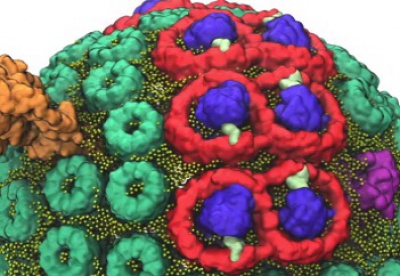
Photosynthetic light harvesting: Three decades of research in motion
Klaus Shulten has been studying the different components of the chromatophore for more than three decades. This multidisciplinary project involves experimentalists doing high-resolution imaging using many kinds of experimental imaging modalities, computer scientists who write software to simulate the structures, and many biophysicists, physicists, and chemists that study the actual science of how these machines work.
Video includes the techniques that were used to build, simulate, analyze, and visualize the structures shown, and the authors highlight cases where scientific needs spurred the development of new parallel algorithms to harness GPU accelerators and petascale computers. Video and cover image courtesy the Theoretical and Computational Biophysics Group at the University of Illinois at Urbana-Champaign, US.
The cellular process responsible for providing energy for most life on Earth — photosynthetic light-harvesting — requires the cooperation of hundreds of proteins across an organelle, involving length and time scales spanning several orders of magnitude over quantum and classical regimes.
The Theoretical and Computational Biophysics Group and the Center for the Physics of Living Cells at the University of Illinois at Urbana-Champaign, US, received the SC14 visualization showcase award at the International Conference for High Performance Computing, Networking, Storage and Analysis. The movie is the culmination of three decades of modeling efforts, featuring the collaboration of theoretical, experimental, and computational scientists.
Today, even the best human-made solar cells are only 15-25% efficient in converting the energy of light into electricity. But this naturally evolving organism reaches near 96% efficiency under much more adverse conditions. Its complex internal machinery even enables it to repair itself. Scientists and engineers hope to one day develop synthetic light harvesting apparatuses that can offset the 15-terawatt-per-year energy demand made by humans worldwide.
- Amber Harmon
Digital Stream
-
Following last week's big #DigitalSingleMarket announcement, check out these great #InternetofThings explainer videos http://t.co/tJ9jiZGRpe
40 min 29 sec agovia Twitter
-
ICYMI: #HPC resources & hi-res satellite imagery used to aid #NepalEarthquake disaster relief: http://t.co/1oFT4oRPZ9 http://t.co/uwPJt5R8rI
3 hours 22 min agovia Twitter
-
(5/5) Top five stories in #iSGTW history: #1 "Turning the microscope inwards" | http://t.co/4mugeU0vRT http://t.co/w8uKI660Ek
12 hours 48 min agovia Twitter


Comments
Post new comment