
Sifting big data to anticipate solar flares
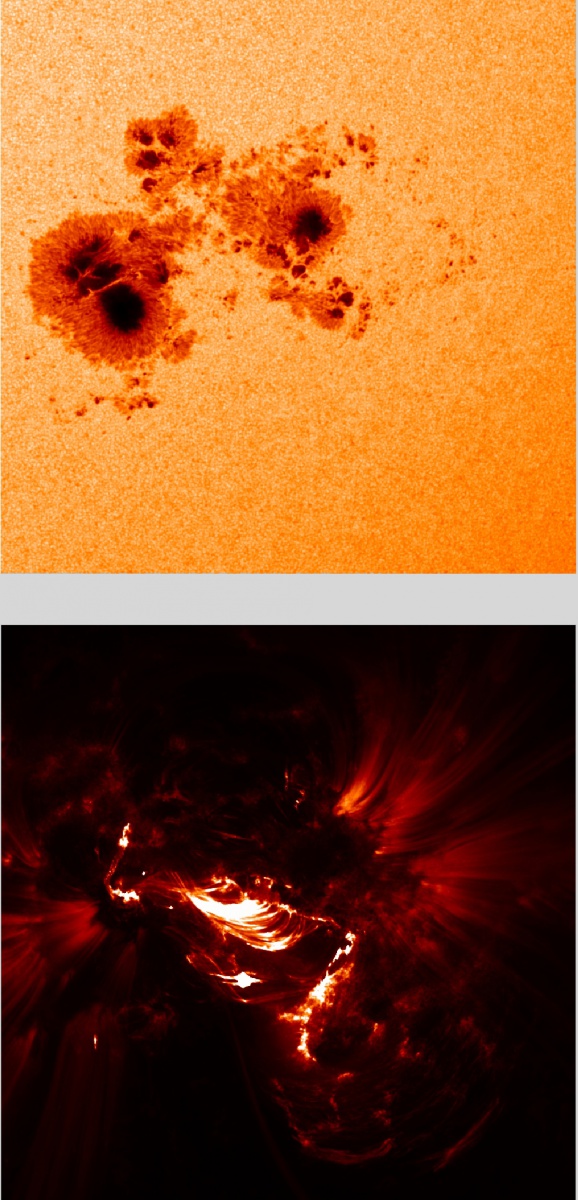
X-class flare from October 2014. The upper panel shows the flare at the solar surface as seen from the HMI. The lower panel shows the same flare in the corona as imaged by the AIA. In the worst-case scenario, an astronaut caught in a solar eruption outside the International Space Station could receive a lethal dose of radiation very quickly. Courtesy of NASA/SDO and the AIA, EVE, and HMI science teams.
It takes 30 minutes for x-rays from solar flares to reach our planet. The Earth’s magnetosphere protects us most of the time, yet the biggest solar eruptions sometimes breach this defense. By applying machine-learning algorithms to satellite data, solar physicists Monica Bobra and Sebastien Couvidat have made solar flare prediction a live possibility.
Solar flares send streams of x-rays and plasma into the surrounding solar system and can wreak havoc on the sensitive instruments onboard satellites orbiting our planet. For instance, if Global Positioning System (GPS) service is interrupted, our ability to navigate down below suffers.
In the case of the largest solar eruptions, depending on the direction in which they are jettisoned, some of the charged particles will reach the Earth's surface and disrupt our power grid, which can then lead to a cascade of other troubles.
“It’s not science fiction. It’s something that did happen in the past, and remains a problem,” Couvidat says.
In an effort to avert these problems, Bobra and Couvidat — both based at Stanford University, California, US — developed a technique to quickly analyze the 1.5 terabytes of data streaming daily from the Solar Dynamics Observatory (SDO). NASA launched SDO to keep an eye on the sun and learn how space weather is affected by solar activity.
To achieve their breakthrough forecasting technique, Bobra and Couvidat employed a machine-learning algorithm to comb through four years of data collected by the Helioseismic and Magnetic Imager (HMI), an instrument designed in the Stanford lab and now onboard the SDO. The HMI studies the magnetic field and oscillations on the sun’s surface, and has been streaming images back to a dedicated ground station at a continuous rate of 130 Mbps since May 2010.
Most solar measurements in the past only observed the strength of a solar magnetic field. In addition to providing continuous observation of the entire solar disc — so that a rare X-class flare isn’t likely to be missed — the HMI allows scientists to measure both the strength and the direction of the magnetic field of the active regions.
To improve their analysis, Couvidat and Bobra will add data from the Atmospheric Imaging Assembly (AIA), another instrument onboard the SDO. The AIA provides images from the sun’s corona, capturing information about the magnetic field closer to where flares occur.
Couvidat envisions their research leading to early warning detection systems so that satellites can turn off instruments and reorient shields to deflect the harmful particles.
Having an ability to react to solar eruptions in time is more important now than ever before, Couvidat maintains. “As our society is becoming more and more technological, we rely more and more on things like satellite data and satellite links; therefore, we are more sensitive to these kind of solar eruptions.”
--Lance Farrell
Digital Stream
-
#Twitter followers now at 2,524. Life is good! Follow --> @SciNode today New website coming 9/16 --> http://t.co/OveWjfrSGj
1 day 10 hours agovia Twitter
-
New name, new website: Same plain language, real world science content. -- Are you following @SciNode yet? http://t.co/TFJ0h5BILL
1 day 12 hours agovia Twitter
-
RT @science360: Oxygen oasis in #Antarctic lake reflects distant past. #NSFfunded #research at @ucdavis http://t.co/ARZkRyFtcK
5 days 7 hours agovia Twitter


Comments
Post new comment