
A case for computational mechanics in medicine
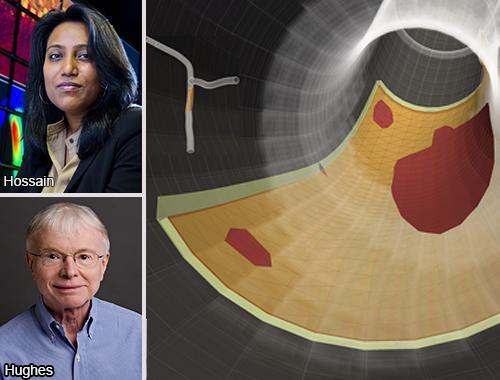
Members of the US National Committee on Theoretical and Applied Mechanics and collaborators, including Thomas Hughes, director of the computational mechanics group at the Institute for Computational Engineering and Sciences (ICES) at The University of Texas at Austin, US, and Shaolie Hossain, ICES research fellow and research scientist at the Texas Heart Institute, have published an article reviewing the new opportunities computational mechanics is creating in medicine.
New treatments for tumor growth and heart disease are just two opportunities presenting themselves. The article is published in the Journal of the Royal Society Interface. “This journal truly serves as an interface between medicine and science,” Hossain says. “If physicians are looking for computational research advancements, the article is sure to grab their attention.”
The article presents three research areas where computational medicine has already made important progress, and will likely continue to do so: nano and microdevices, biomedical devices — including diagnostic systems, and organ models — and cellular mechanics.
“[Disease is a] multi-scale phenomena and investigators research diverse aspects of it,” says Hossain, explaining that although disease may be perceived at an organ level, treatments usually function at the molecular and cellular scales.
Hughes and Hossain’s research on vulnerable plaques (VPs), a category of atherosclerosis responsible for 70% of all lethal heart attacks, is an example of applied research incorporating all three notable areas.
“The detection and treatment of VPs represents an enormous unmet clinical need,” says Hughes. “Progress on this has the potential to save innumerable lives. Computational mechanics combined with high-performance computing provides new and unique technologies for investigating disease, unlike anything that has been traditionally used in medical research.”

The high mortality rate attributed to VPs stems from their near clinical invisibility; conventional plaque detection techniques such as MRI and CT scanning do not register VPs because significant vascular narrowing is not present. Hughes and Hossain, however, have developed a computational toolset that can aid in making the plaques visible through targeted delivery of functionalized nanoparticles.
Their computational models draw on patient-specific data to predict how well nanoparticles can adhere to a potential plaque, thus enabling researchers to test and refine site-specific treatments. If a VP is detected, the same techniques can be employed to send nanoparticles containing medicine directly to the VP.
The models are being applied at the Texas Heart Institute, where Hossain is a research scientist and assistant professor. “Early intervention and prevention of heart attacks are where we certainly want to go and we are excited about the possibilities for computational mechanics being a vehicle to get us there safely and more rapidly,” says James Willerson, Texas Heart Institute president.
Other computationally aided models are already being used to help physicians evaluate and treat patients. HeartFlow, a company founded by Charles Taylor, uses CT scan data to create patient-specific models of arteries, which can be used to diagnose coronary artery disease.
Despite its success and demonstrated potential, computational mechanics in the medical field is still a new concept for scientists and physicians alike, says Hossain. “The potential that we have, in my opinion, hasn't been tapped to the fullest because of the gap in knowledge.”
To help integrate medicine into a field that has historically focused on more traditional engineering domains, the article advocates for incorporating biology and chemistry questions into computational mechanics classes, as well as offering classes that can benefit both medical and computational science students.
Adapted from Monica Kortsha’s article: Hughes and Hossain make case for computational mechanics in medicine in interdisciplinary journal
Comments
Post new comment